Young Women Often Trendsetters in Vocal Patterns
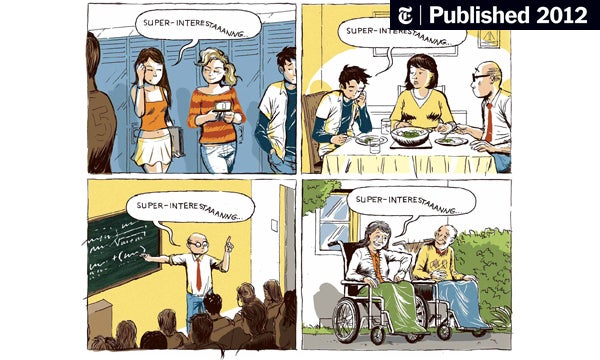
Even an American president has been known to uptalk. “George W. Bush used to do it from time to time,” said Dr. Liberman, “and nobody ever said, ‘Oh, that G.W.B. is so insecure, just like a young girl.’ ”
The same can be said for the word “like,” when used in a grammatically superfluous way or to add cadence to a sentence. (Because, like, people tend to talk this way when impersonating, like, teenage girls?) But in 2011, Dr. Liberman conducted an analysis of nearly 12,000 phone conversations recorded in 2003, and found that while young people tended to use “like” more often than older people, men used it more frequently than women.
And, actually? The use of “like” in a sentence, “apparently without meaning or syntactic function, but possibly as emphasis,” has made its way into the Webster’s New World College Dictionary, Fourth Edition — this newspaper’s reference Bible — where the example given is: “It’s, like, hot.” Anyone who has seen a television show featuring the Kardashian sisters will be more than familiar with this usage.
“Like” and uptalk often go hand in hand. Several studies have shown that uptalk can be used for any number of purposes, even to dominate a listener. In 1991, Cynthia McLemore, a linguist at the University of Pennsylvania, found that senior members of a Texas sorority used uptalk to make junior members feel obligated to carry out new tasks. (“We have a rush event this Thursday? And everyone needs to be there?”)
Dr. Eckert of Stanford recalled a study by one of her students, a woman who worked at a Jamba Juice and tracked instances of uptalking customers. She found that by far the most common uptalkers were fathers of young women. For them, it was “a way of showing themselves to be friendly and not asserting power in the situation,” she said.
Source link