
Inflation: The Recent Past and the Future | Speeches

Good afternoon. I would like to thank BankSA for the invitation to speak in Adelaide
today. It is a pleasure to be here.
The topic that I would like to talk about this afternoon is inflation, which ties
in very nicely with the main theme of BankSA’s quarterly bulletin which
is being released today. First, I will talk in some detail about the distinct
cycle in underlying inflation that we have seen in Australia over the past
six years or so. After that, I will discuss the lessons that we might take
from this cycle, as well as the broader lessons we have learnt from the past
two decades of inflation targeting in Australia.
The Recent Cycle in Inflation
I would like to start with the cycle in underlying inflation that began in the mid
2000s (Graph 1).
Graph 1
Across a range of measures, this cycle has been the most pronounced since the introduction
of inflation targeting in the early 1990s. Between 2005 and September 2008,
underlying inflation rose by more than 2 percentage points from around 2½ per
cent to just above 4½ per cent. Then, since late 2008, underlying inflation
has steadily declined to be around 2¼ per cent over the year
to March 2011.
As the RBA discussed in the latest Statement on Monetary Policy, this decline in underlying inflation
looks to have now run its course and a gradual rise is expected over the next
couple of years. Given this, it is timely to look back and to review what caused
the recent cycle and what lessons it holds for our understanding of the inflation
process.
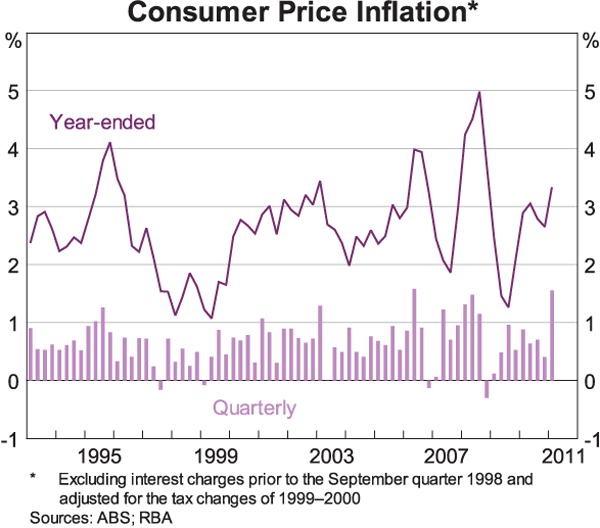
Before doing this it is worth noting that a cycle in headline CPI inflation is less
obvious (Graph 2). This largely reflects the quarter-to-quarter volatility
in the prices of fuel and fruit & vegetables. This volatility has been
especially pronounced over recent years, partly because of the effects of Cyclones
Larry and Yasi on banana
prices.
This volatility is also one reason that we often use the various underlying
measures when assessing the ongoing inflation pressures in the economy.
Graph 2
At a general level, the fact that underlying inflation picked up between 2005 and
2008, and then subsequently declined, is hardly surprising. In the period immediately
prior to the North Atlantic financial crisis, global commodity prices were
rising strongly, the unemployment rate in Australia had fallen to its lowest
level in more than three decades and there was considerable pressure on capacity
in the economy. The result was a pick-up in inflation. Then when the slowdown
occurred, pressures on capacity eased and global commodity prices fell. Again,
not surprisingly, the result was a moderation in inflation.
What did, however, surprise us somewhat was the amplitude and the timing of this
cycle in inflation. Within the RBA, the staff run a number of standard ‘workhorse’
models based on historical relationships to help explain and forecast
inflation.
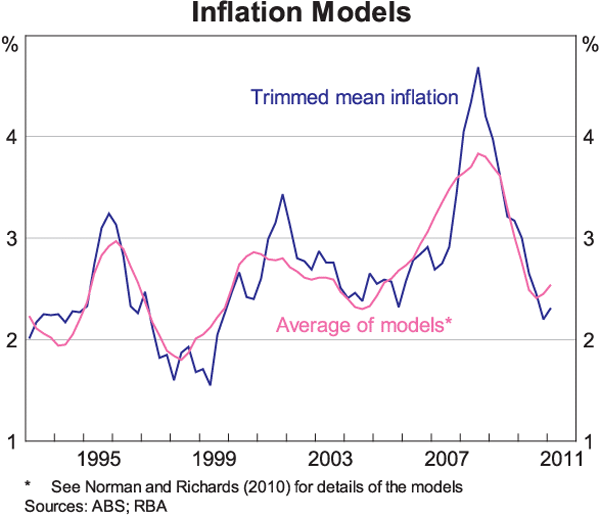
While these models are all consistent with a pick-up, and then moderation,
in inflation, they have difficulty explaining the amplitude of the recent cycle.
This is obvious from Graph 3 which shows the average fitted values of four
of these models, along with the trimmed mean measure of underlying inflation.
In mid 2008, for example, underlying inflation was around ¾ of a percentage
point higher than can be explained by the average of these models, and none
of the models can explain why underlying inflation reached over 4½ per
cent. In contrast, during the period 2005 to 2007, inflation was mostly lower
than can be explained by these models.
Graph 3
The general picture that one gets from this analysis is that underlying inflation
in Australia was slower to pick up than suggested by the historical relationships,
but when it did eventually pick up, it did so more quickly, and by a larger
amount, than suggested by these relationships.
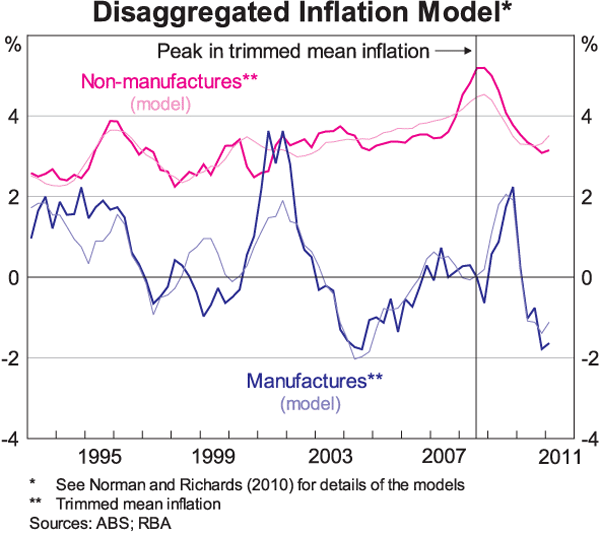
When we look closely at the details of the CPI, it is clear that this pattern is
largely accounted for by the prices of services. This can be seen in Graph
4 which shows the inflation rate for manufactured goods in the CPI separately
from that for non-manufactured items. Over the past decade, movements in the
prices of manufactured goods are reasonably well explained by import prices,
the exchange rate and labour costs. In comparison, over this period, the historical
relationships do less well in explaining the inflation rate for non-manufactured
items; the models over-predicted inflation in the middle years of the decade
and then later under-predicted inflation.
Graph 4
This overall pattern of surprisingly stable inflation for a few years and then a
sharp pick-up is evident in the RBA’s own inflation forecasts over this
period. In late 2006 and early 2007, the outcomes for underlying inflation
were surprisingly well contained. At the time, we and others wondered whether
something had changed significantly in the inflation process. But not long
after that, the inflation outcomes were turning out to be considerably higher
than we had expected. In fact, the difference between the RBA’s 18-month-ahead
forecast for underlying inflation and the actual outcome over the year to September
2008 was the largest over the inflation-targeting period.
In trying to understand this experience, there are three specific issues that I would
like to touch on: the evolution of unit labour costs; the impact of housing-related
costs on the CPI; and the role of international factors.
Unit labour costs
In the long run, movements in unit labour costs – i.e. average labour costs
per unit of output – have an important bearing on the rate of inflation.
Over the inflation-targeting period, unit labour costs have increased at an
average annual rate of 2.6 per cent and the CPI inflation rate has averaged
2.7 per
cent.
The fact that these two numbers are so close to one another is no accident.
If the profit share is to remain relatively steady over time, average growth
in unit labour costs needs to be consistent with inflation target.
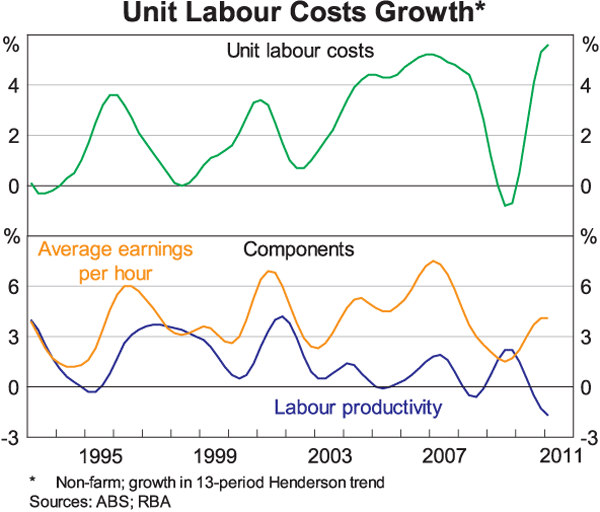
Of course, in the short run, the link between unit labour costs and inflation is
not nearly as tight. In the recent cycle, growth in unit labour costs picked
up in 2004 and remained high until late 2008 (Graph 5). This was the result
of both faster growth in average labour costs and slower growth in productivity.
Graph 5
The pick-up in labour costs in the middle years of the 2000s is evident in a wide
range of measures. Not only was there a lift in annual wage increases as the
labour market tightened, but there were reports of many firms upgrading positions
in an effort to retain and attract staff, with the upgraded positions attracting
higher rates of pay. Some firms also increased the bonuses and other benefits
paid to their staff.
This increase in labour costs coincided with a period of slower growth in labour
productivity. Since 2005, estimated labour productivity growth has averaged
less than ½ per cent per year, compared with average growth of
2 per cent over the 1990s. The reasons for this slowdown are not
fully understood, although it may partly be a result of the high commodity
prices that have allowed lower quality and/or more costly mines to be developed.
In any case, productivity growth will need to pick up again if our living standards
are to improve at the rate we have become accustomed to over the past two decades.
This is a major challenge facing both the private and public sectors.
Looking back to the recent cycle in inflation, it is clear that developments in unit
labour costs had a significant role, both in contributing to the increase in
inflation and then to its decline. But they provide only a partial explanation,
and alone cannot explain why inflation picked up so sharply in 2007 after having
been stable over the preceding few years. One possible explanation for this
pattern is that there is some threshold in capacity utilisation which when
crossed causes inflation to increase very quickly. An alternative explanation
is that the short-run dynamics of underlying inflation were influenced by other
factors during this period. It is difficult to formally test these two explanations,
but other factors do appear to have played a significant role. Of these, developments
in housing costs were perhaps the most important.
Housing cost inflation
Currently, housing-related costs – including rents, utilities and the cost
of building new dwellings – account for around 20 per cent
of the CPI, the largest share of any single group. Broadly speaking, the housing
component of the CPI shows the same general pattern as that in underlying inflation,
although the recent moderation is less pronounced (Graph 6).
Graph 6
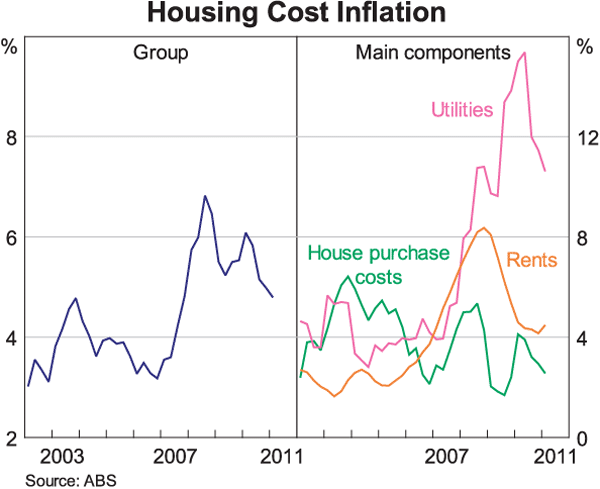
A couple of factors are important in explaining this general pattern.
The first is that the large run-up in Australian house prices that was driven by
the adjustment to low inflation ended in late 2003. When the housing boom came
to an end, building cost inflation came down and growth in rents was subdued
for a few years. These outcomes helped hold down overall inflation rates during
this period. But by 2007, the cycle had again turned, with building costs rising
more quickly and growth in rents accelerating. This faster growth in rents
reflected the changing balance of demand and supply in the rental market, with
strong population growth coinciding with relatively slow expansion of supply.
The second factor has been utilities prices. During the middle years of the 2000s
utilities prices were increasing at an average rate of 4 per cent, which was
slightly lower than that in the previous few years. Then from 2007, utilities
price inflation accelerated sharply. The proximate cause was the regulatory
decisions allowing double-digit price increases, partly to help fund infrastructure
investment, particularly for the distribution of electricity. But a deeper
cause was the low levels of investment in previous years, which meant that
the capacity of the system to distribute electricity had not kept pace with
the growth in demand, particularly during hot
weather.
While these developments in rents and utilities do help explain the particular dynamics
of inflation over the recent cycle, they also demonstrate that when the economy
is operating up against supply constraints, all sorts of prices – and
not just the price of labour – start rising more quickly.
International factors
The third issue that I would like to touch on is the role of international factors.
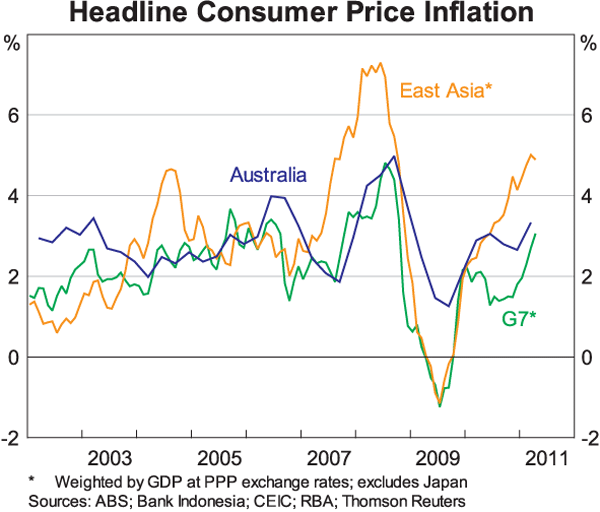
Looking at headline inflation rates across countries over recent years, there is
a deal of similarity in the movements (Graph 7). Many countries in both
Asia and the North Atlantic experienced increases in headline inflation rates
in 2007 and 2008 and many experienced declines in late 2008 and in 2009. This
co-movement partly reflects the large changes in global commodity prices over
recent years. When global oil prices went up, they boosted the CPI in almost
all countries, and when they went down during the financial crisis, they led
to CPI inflation falling almost everywhere. Movements in food prices had a
similar global effect.
Graph 7
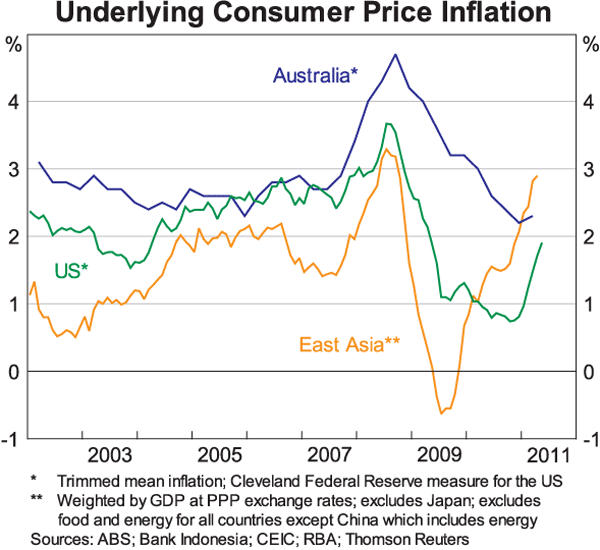
In terms of underlying inflation, we also see some co-movement across countries over
recent years, although somewhat less than in headline inflation (Graph 8).
When underlying inflation in Australia was rising, so too were equivalent measures
of underlying inflation in the United States, as were exclusion-based measures
of core inflation in most Asian
countries.
Similarly, measures of underlying inflation fell almost everywhere in the aftermath
of the financial crisis, although there has been more dispersion recently.
These common movements reflect the correlation in the business cycle across
countries, as well as the flow-on effects of the large changes in global commodity
prices to the prices of a wide range of final goods and services.
Graph 8
Movements in the exchange rate have also influenced inflation outcomes over recent
years. In particular, the trend appreciation of the Australian dollar from
2002 has helped hold down the prices of many imported manufactured goods. For
example, the price index for household electrical appliances is 8 per
cent lower than it was nine years ago. Over this same period, clothing prices
have fallen 10 per cent, the price of shoes by 13 per cent and
the price of manchester by 24 per cent. These are all large price declines.
Around the trend appreciation of the exchange rate there have, however, been significant
swings. In particular, the large depreciation of the currency as a result of
the financial crisis saw the prices of many manufactured goods increase in
2009. These increases slowed the moderation in underlying inflation during
this period. More recently, the subsequent appreciation of the currency has
led to quite large falls in the prices of many manufactured goods. Overall
though, these swings in the exchange rate have played only a relatively minor
role in explaining the recent cycle in underlying inflation which has been
primarily driven by domestic factors.
Some Lessons
So to summarise, an important lesson from this recent experience is that inflation
responds to the changing pressures on capacity in the economy. When demand
is high relative to the economy’s capacity to produce goods and services,
the cost of labour and raw materials tend to rise and firms’ mark-ups tend
to increase. Conversely, when demand is low relative to the economy’s capacity
to produce goods and services, these pressures ease and inflation tends to
fall.
It is also clear that the dynamics of the recent cycle in inflation were influenced
by capacity pressures in the housing market and by developments in utilities
prices. They were also influenced by capacity pressures in the global markets
for commodities. But these factors alone fall well short of fully explaining
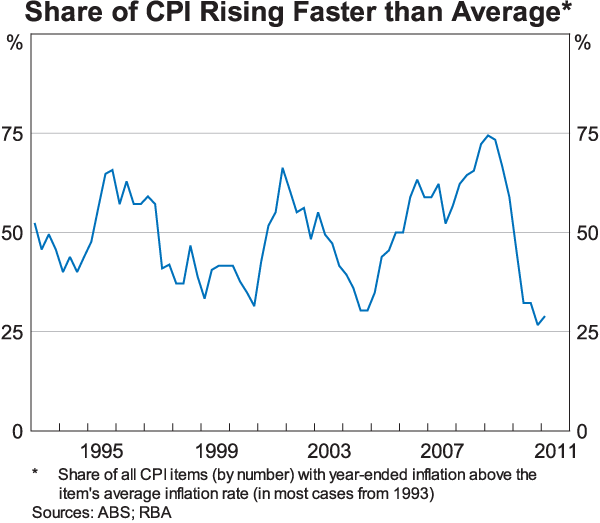
the cycle, with the upward pressure on prices in 2008 being very widespread.
At that time, around three-quarters of the 90 individual items in the CPI were
increasing at faster than their average rate of the previous two decades (Graph 9).
Similarly, the deceleration of inflation since September 2008 has been widespread,
with the prices of relatively few items currently increasing at faster than
their average rate.
Graph 9
Looking at the experience over the past six years as a whole, it is clear that the
protracted period of above-average growth in unit labour costs did eventually
lead to higher inflation and this was compounded by a variety of other capacity
pressures in the economy. Subsequently, the slowing in unit labour costs during
the downturn and the easing of these other capacity pressures saw inflation
moderate significantly.
But looking beyond this recent cycle, the past 20 years carry a broader and more
important lesson. And that is the economy works better with low and stable
inflation, and that the monetary policy framework matters.
In the 1970s and 1980s we saw the consequences of high inflation rates. Inflation
eroded the value of people’s hard-earned savings. It made long-term planning
difficult. It added to uncertainty. It distorted investment decisions. And
as the late 1980s showed it made leveraged asset purchases an easier path to
wealth than hard work. The end result was slower growth and greater economic
volatility.
High inflation also meant high interest rates. In the 1980s, the inflation rate averaged
8 per cent, and the mortgage rate averaged 13 per cent and peaked
at 17 per cent. In contrast, since 1993 inflation has averaged just a
little above 2½ per cent and the mortgage rate has averaged
7½ per cent. And the volatility of both inflation and interest rates
has also been lower under the inflation targeting regime. The clear lesson
here is that changes in the average inflation rate ultimately lead to changes
in average interest rates, including those on mortgages.
Today, most people take low inflation as a given, as a permanent part of our economic
landscape. Inflation expectations are well anchored and the possibility of
a rapid increase in the general price level is not something that most people
worry about. This is how it should be. There are enough uncertainties in today’s
world, without adding uncertainty about the average rate of inflation to the
list.
For all these reasons, there is broad community acceptance that the main contribution
that the Reserve Bank can make to strong sustainable growth in the Australian
economy is to maintain low and stable inflation. In concrete terms, our objective
is to keep the average rate of inflation over time somewhere between 2 and
3 per cent. We have achieved this over the past two decades, and this has been
one of the key building blocks for Australia’s strong economic performance.
Importantly, we have had from the start a flexible inflation targeting regime focusing
on medium-term outcomes, which is what ultimately matters to both households
and businesses. Under this framework, inflation has been both below, and above,
the 2–3 per cent range. The framework allows us to respond to one-off
events and to large changes in world relative prices in a way that promotes
economic stability and the framework has been important in anchoring inflation
expectations.
Looking ahead, as the Bank has discussed recently, the current environment is a particularly
challenging one. In the central scenario, we are looking at a significant boom
in investment in the resources sector at a time when the overall economy has
relatively little spare capacity. While conditions are very strong in parts
of the economy, other parts are finding things very difficult because of either
the high exchange rate or the ongoing restraint in household spending and borrowing.
And to add to the complications, global commodity prices are undergoing a structural
shift as hundreds of millions of people in Asia enter the global economy.
It is not easy to navigate our way through this difficult environment. The new realities
of the global economy have improved Australia’s medium-term prospects.
At the same time though, they are causing considerable structural change in
the economy which is leading to difficulties in a number of areas. As Australia
takes advantage of its new opportunities and manages the process of structural
change the task for the RBA is to keep inflation low and stable. By doing this,
we can help promote sustainable growth in jobs and as well as economic and
financial stability. Over the past 20 years, low inflation has been a
key ingredient to Australia’s economic success and maintaining that record
will help us meet the challenges that lie ahead.
Thank you.
Source link